
I was at the Chicago Pride Parade. It’s not something I always do, but this one felt important. It was the first one my new partner and I had done together. (The backstory on this is for a different practice.)
In preparation for a hot day, I dressed as light as possible and quickly realized I was showing more skin than usual. BTW, said everyone at a Pride parade! So I shrugged it off.
As I looked in the mirror to complete the final assessments on my ‘fit, I noticed how everything looked with my new, very short haircut. That engulfed me in a memory. I recalled the countless times in 2024: people constantly told me how “different” I looked. Some even said that they didn’t even recognize me at first.
I had been through my share of recent life transitions. Endings, beginnings, and everything in between. But I liked the way I looked and felt. I finally felt like me. So, when people noticed, I realized that was just their way of reconciling it all. This was the first time in my life that I wasn’t threatened by it.
Still, I was getting used to this new feeling after an entire life of masking, of becoming whomever I thought I needed to be just to get by. So, when someone held up a mirror, I just observed. I wasn’t trying to prove anything. I took it as an opportunity to further settle into myself.
The parade was busy. Full of people. As we walked south down historic Halsted Street, we decided to camp out in front of The Center on Halsted, a historic LGBTQ+ organization in Chicago. I was holding my partner’s hand, immersed in people watching, dancing, and queer joy all around us. It was one of those moments where you get so drawn in that you forget where you are. It was blissful.
And that’s when I heard it.
LaTonya?!
My name was called out with a kind of reluctant surprise. I looked up. A former student. She re-introduced herself to help my mesmerized brain catch up.
Then she studied me. I wasn’t the professor she remembered from the classroom. I was with an unfamiliar person (who was obviously my partner), affectionate, tattoos visible, hair short, no blazer. I was confident in my own skin. I was in my natural habitat.
I noticed myself shift into coach mode mid-conversation. And when she walked away, I tried to make sense of this brief interaction.
Why did that feel so strange? Why couldn’t I stop thinking about it?
Then came the real reflection. I finally named it.
I had masked my full self for so long that this moment felt like an invasive mirror held directly to my face.
I started asking questions I had never fully sat with: Why did I do this for so long? Who did I do it for? What did this actually get me?
My Life Has Been Full of Masking
In Leading Below the Surface, I wrote about how much of a norm it was to mask throughout my career. My personal narrative was that I did it to survive. To make others comfortable. I did it to get ahead. But did it actually work?
I did a brief exercise to find out. I went back through every job I’d had and noted two things:
- The degree of masking I did in that role
- The level of success I experienced as a result
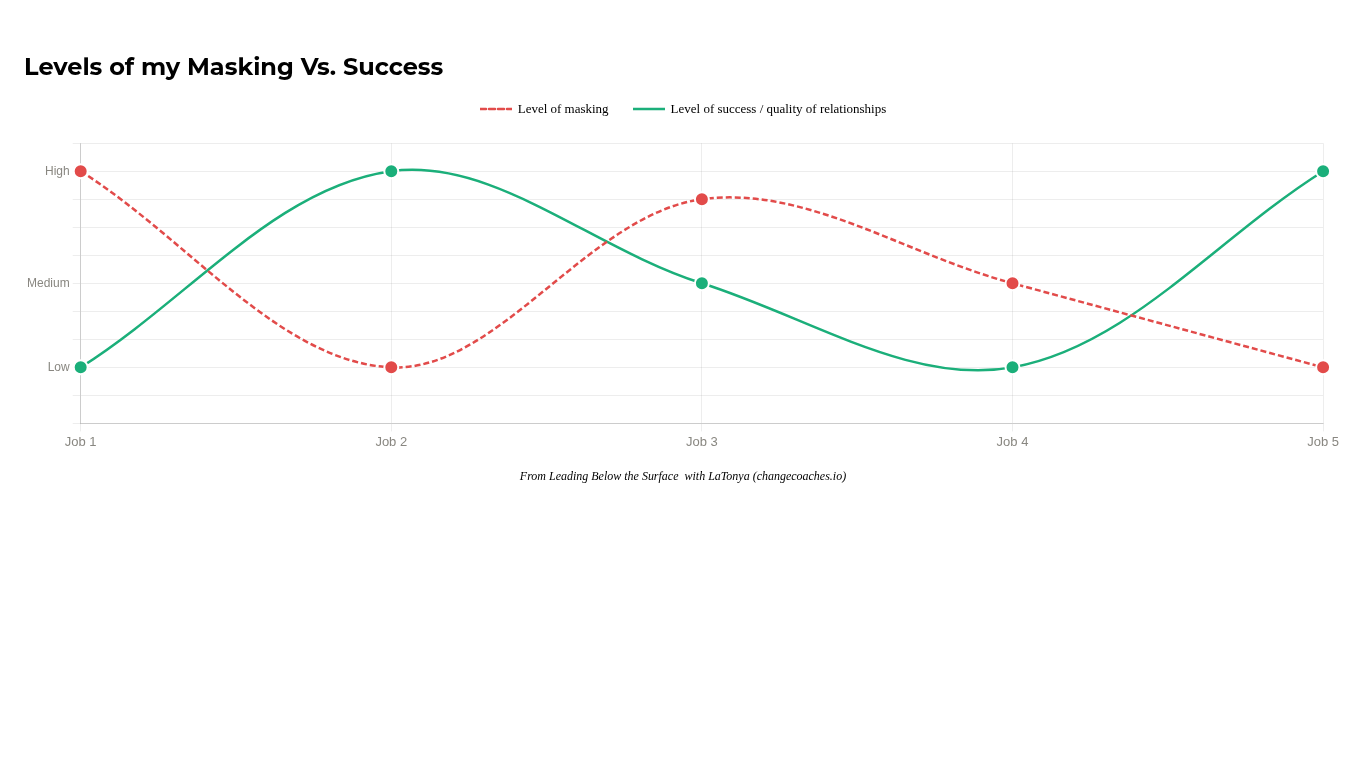
As you will quickly observe, masking and my success have had an undeniable inverse relationship. The more I masked, the less success I had. In one role in particular, I felt completely stagnant. I just wanted to keep my job through a difficult economic moment, and while masking achieved that, I wasn’t growing, learning, or thriving. I was bored. I felt…blah.
Try it yourself. Grab a piece of paper and draw two axes. On the x axis, list your jobs or significant life situations in order. On the y axis, rate your level of success or quality of relationships during each one. Then go back and honestly note how much you were masking at each point.
See what the data tells you. Most people are surprised by what they find, and how clear it all is. I wouldn’t be surprised if you noticed something similar.
The Moment I Decided to Stop
One of the reasons I started a business was because I wanted to stop masking. I wanted to build something real, not report to someone who required me to suppress the most unique parts of myself.
Before I could go fully out on my own, I took a strategic detour. My first venture into academia gave me exactly what I was looking for: freedom, new ideas, and room to create. It was in a business school, so they were very interested in innovation. I was the first person in that role, and I made the most of it. For a while, I operated mostly unmasked.
Then my grandmother passed. And I started writing Leading Below the Surface.
That’s when the necessary endings and beginnings started. And they haven’t stopped since.
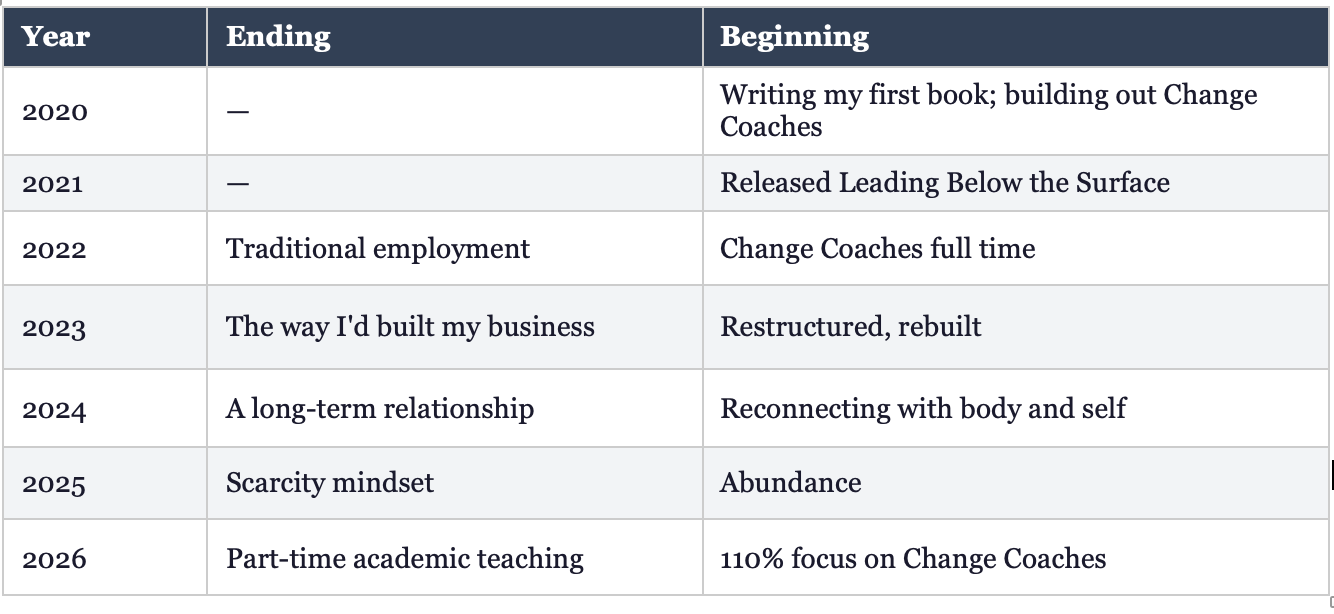
Upon completing and observing this timeline, something jumped out at me. The first two years had no endings, only beginnings. And I’ve come to believe that endings and beginnings need to remain in balance. When we avoid endings for too long, we accumulate a kind of deficit. And eventually, the forces beyond us need to balance things out.
That’s exactly what happened to me. The years of endings that followed were what I call ‘catching up.’ I had deferred too many necessary endings, and the balance had to be restored.
Take a minute and create your own timeline.
Where are you heavy on beginnings and light on endings? Where have you been holding on past the point of knowing it was time to let go? That imbalance has a cost, and it shows up in your energy, your relationships, and the version of yourself that you are unnoticeably blocking.
You might be surprised by what’s overdue.
Signs You Need a Shift — And How to Begin
Most people don’t wake up one day and decide to stop masking. It happens more quietly than that. You just notice, over time, that something feels off. That the version of you showing up at work, in relationships, or in your own mirror doesn’t quite match who you know yourself to be.
Here are some signs that a shift might be overdue. And, if you remember my article about transformation, go back to that as well for more ideas.
Symptom 1: You feel exhausted; no amount of sleep or relaxation can fix it.
Symptom 2: You constantly tell yourself something like “this isn’t a big deal to me” but your actions say otherwise.
Symptom 3: You know what you’d do differently, but you haven’t let yourself do it yet. There’s always one very convincing excuse or another.
Symptom 4: The people closest to you don’t fully recognize you, because they’ve only ever seen glimpses of the real you, not the whole person consistently.
Symptom 5: You have more endings you’ve been avoiding than beginnings you’ve been planning.
As for me, symptoms 2, 3, and 4 were the culprits. My classic line to myself was “this isn’t a big deal to me” when my friends would observe that I wasn’t telling myself the truth. I had also convinced myself that I was right where I needed to be. I was stuck in what we might call septic sequencing. Yes, it’s supposed to sound toxic because it is. We stay stuck, but the if never comes for the then.
Mine were constant:
- If I sign this client, then I’ll feel good about my goals.
- If this person comments, then I know what I’m putting in the world is valuable.
- If this happens one more time, then I’ll leave.
But, in many of those instances, my mind was either made up, or I already had the data I needed. More data wasn’t helping. It was just increasing toxicity.
If You Feel A Deficiency
I get into this more in Leading Below the Surface with LaTonya, but I have a feeling that if you got this far, something is resonating.
Maybe you have an endings deficit, or maybe you are realizing that your masking hasn’t helped. It’s also possible that you are stuck in the symptoms I named earlier. Or perhaps you can’t quite name them, but these have activated something in you.
There are a few ways to go deeper:
- Subscribe to my biweekly newsletter, Leading Below the Surface with LaTonya. It’s free, and this kind of work goes deeper there.
- Attend my free webinar this week.
-
Register here:
- Reach out about Leading Below the Surface: Relational Coach Training (also known as Coaching Below the Surface, or CBTS). Leadership and coaching competencies are more aligned than most people realize, and you can’t develop either without doing the identity work below the surface.