
The other day, I had coffee with someone from my past. Someone I’ve known across many chapters of life, but don’t see often.
For most of those chapters, this person was defined by their work. Competitive. Structured to the point that some would say rigid. Very corporate, very achievement-oriented, deeply invested in meritocracy. Work wasn’t just what they did. It was who they were. They worked hard to get where they were and expected the same of others. In Leading Below the Surface, I call this the dominant leadership standard. It’s steamrolling all of the things that make us human to achieve “success.” This is exactly what they valued.
Then they lost their job.
And over the last couple of years, I’ve watched something unexpected happen. This person feels like a different version of themselves. Some people call it the “soft person era.” But I think it’s something more significant than that. They are more inclusive now. Calmer. Constantly questioning what came before: the values they operated from, the assumptions they never examined, the way they led and lived.
I’ve been genuinely surprised by some of the things they now say.
Do you know someone like this? I’m certain you do. Because I’m seeing it everywhere: in clients, in colleagues, in leaders who have “done everything right” and are still arriving at the same question:
Who am I now? And what do I actually stand for?
Not who your company or organization wants you to be? Not who you feel pressured to be to conform. But who am I really?
If this is something you find yourself asking, keep reading, as this is exactly what this article will cover: where we are, how we got here, and how to move with intention into what’s coming next. This isn’t about the trend or flavor of the month. It’s about reading the signs of what’s around us, aligning ourselves, and being part of the ecosystem that is shifting around us.
The Ages — What We Centered and What We Lost
The last few years in the workplace have been exhausting, to say the least. Burnout and loneliness are still at the highest levels. Socially, and as a society, we have not recovered from COVID. People are still struggling to find real connections.
To understand where we are, it helps to look at where we’ve been. Every decade of work has had a theme, something we collectively organized around. I would argue that most of the ages were chosen, except for the COVID age. I will explain this more in the next section.
The Social Age
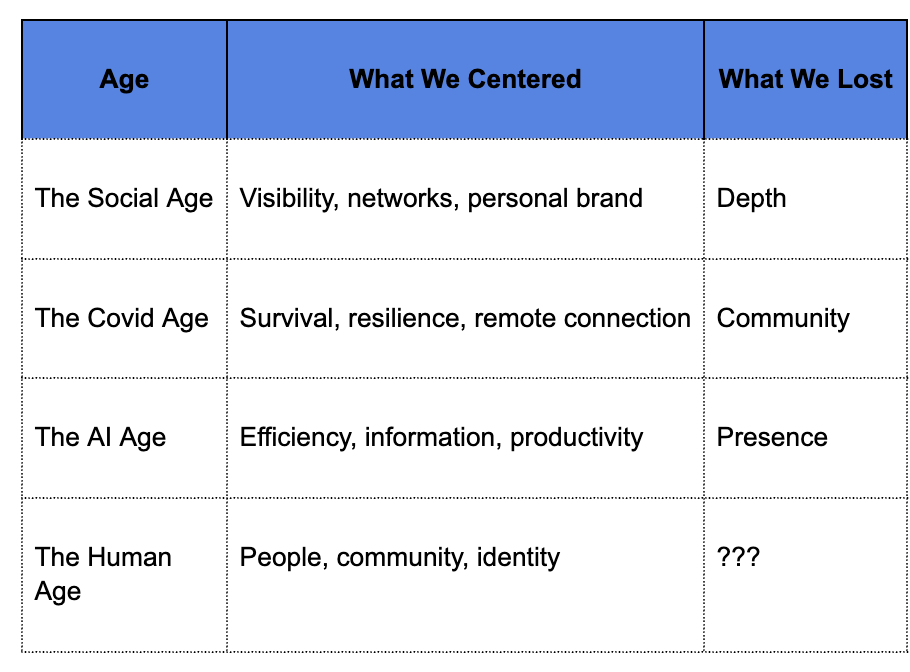
Does anyone remember MySpace? I’m probably dating myself by asking this question. But, seriously. I remember loving MySpace so much that I would lose track of time spending hours reconnecting with people from my adolescent years. The Social Age started with reconnection: finding people we’d lost touch with, building communities around shared interests. Then something shifted. It became about amassing followers, building personal brands, and achieving visibility. We gained reach. We lost depth. Movements emerged, some of the most important social movements of our time happened in this era. But, at the same time, the loss of depth was real.
The COVID Age
COVID forced a reckoning. Overnight, every assumption about how we work, lead, and connect was dismantled. One day, we were all thrown into survival mode. Many people thought of success as simply making it through a full day of work in a makeshift home office. Some of us were even forced to balance all of this with children at home. We lost community. The casual hallway conversation, the spontaneous lunch, the felt sense of being in something together vanished. It was interesting as, during these times, our clients tried and were somewhat successful at virtual community building, but seeing many pivot to in-person “allowances” for lunch and other gatherings was very telling.
The AI Age
We are still in this one. I think we can all agree that AI isn’t exactly living up to its promises. We were told we would be more efficient and productive. But, not only are we busier than ever, AI has created a lot of uncertainty. And for the gains we have made, the cost of efficiency is playing out in real time. We lost presence. We lost the ability to sit with someone, to truly listen, and just be in conversation. We now lay people off in the most inhumane ways. And while having these skills seems like a luxury in these times, they are steadily becoming even more valuable and critical.
The Human Age — The One We’re Entering
I’m naming the age we are entering as the human age because of what it centers: people, community, and identity. And I know what people are craving inside of it. Here are a few characteristics I’m seeing:
- Self-authorship. The desire to know who you actually are. The actual person underneath. I discuss the concept of self-authorship more in Leading Below the Surface.
- Community. Building an ecosystem of real people who will show up, stay, and go below the surface with you.
- Hope. Trust. Courage. Presence. These are not soft skills. In the age we’re entering, they are the most strategic things a leader or coach can develop.
A few things I’ll say about these, all three are in Gallup’s 4 Needs of Followers in one way or another. So this isn’t just me speculating; it has been validated by decades of research.
We’ve Known This. We Just Haven’t Named It.
Recently, during a mentor coaching session, we somehow got on the subject of leaders also being in their cohort. And in that moment, I had an epiphany. I finally could clearly name why leaders are so drawn to this work.
When you review the ICF core competencies, they read like a leadership competency model:
- Cultivates Trust and Safety
- Maintains Presence
- Listens Actively
There are more, but I think you get the gist.
These aren’t just coaching skills. They are the skills the human age is demanding from every leader right now. Most leaders who come to me are struggling to connect with their teams or feeling like something in their leadership is too surface-level and misaligned. And the answer to both is the same.
The competencies that make a great coach make a great leader. We’ve always known this. We just haven’t named it out loud.
And the human age is making it impossible to ignore any longer.
What This Has to Do With Leading Below the Surface: Relational Coach Training
I want to be honest about why I’m writing this. It’s to invite you to be part of something that will build the skills you need for this age.
I built Leading Below the Surface: Relational Coach Training (also known as Coaching Below the Surface) because I saw this gap. I also recognized the era we are entering.
Where was the gap? Well, it included the following:
- Coaches and leaders who were technically proficient but not particularly grounded.
- Programs that taught frameworks but skipped the identity work underneath.
- Coaches who completed training but were still struggling to bring depth into the relationship.
- Cohorts that “graduated” with hours but not with a real sense of who they were as practitioners.
LBS RCT is not a framework. It’s a container. A practice. A 38-hour ICF-approved experience where coaches and leaders do the below the surface work. Curated community + networking, peer coaching, self-discovery, and the kind of learning that builds lifelong confidence and clarity.
What I watch happen in these cohorts goes beyond skill. People understand themselves differently. They find alignment between who they are and how they show up. Some form friendships and professional relationships that last years beyond the program. In the age we’re entering, that is not a nice-to-have. These are the experiences we are all craving. This is part of the human age.
If you’re curious, there are two ways to get started: the Starting Sprint, or you can request an invitation to the next cohort.
And if you lead or work within an organization, Leading Below the Surface: Relational Coach Training for Leaders is coming. More soon. You can learn about both by sending an email to [email protected] or by sending LaTonya Wilkins a DM on LinkedIn.
Closing
Back to the person I had coffee with recently? They didn’t find a new framework. They didn’t take another course. They just finally stopped running from the questions they’d been avoiding for years.
That’s what this age is asking of all of us.
I certainly hope we’re ready.
If this resonated, I go deeper in my biweekly email newsletter, Leading Below the Surface with LaTonya. Subscribe here.
About LaTonya LaTonya Wilkins is an executive coach, author of Leading Below the Surface, and Founder & CEO of Change Coaches. She works with leaders and organizations ready to go below the surface. Learn more at changecoaches.io.